International Law & Human Rights
International law and human rights concern international obligations, relations between States, internationally recognised rights and the interaction between international standards and domestic legal systems. In India, their relevance must be considered within the Constitution, legislation, judicial interpretation, treaty obligations and the institutional framework for the protection of human rights.
Article 51 of the Constitution places international peace, relations between nations, respect for international law and treaty obligations, and settlement of international disputes by arbitration among the Directive Principles of State Policy.
International law and human rights may intersect with constitutional protections, administrative action and remedies available under Indian law. Where an issue principally concerns constitutional remedies, judicial review, writ jurisdiction or the legality of administrative action in India, the relevant framework is addressed separately under constitutional, writ and administrative law matters.
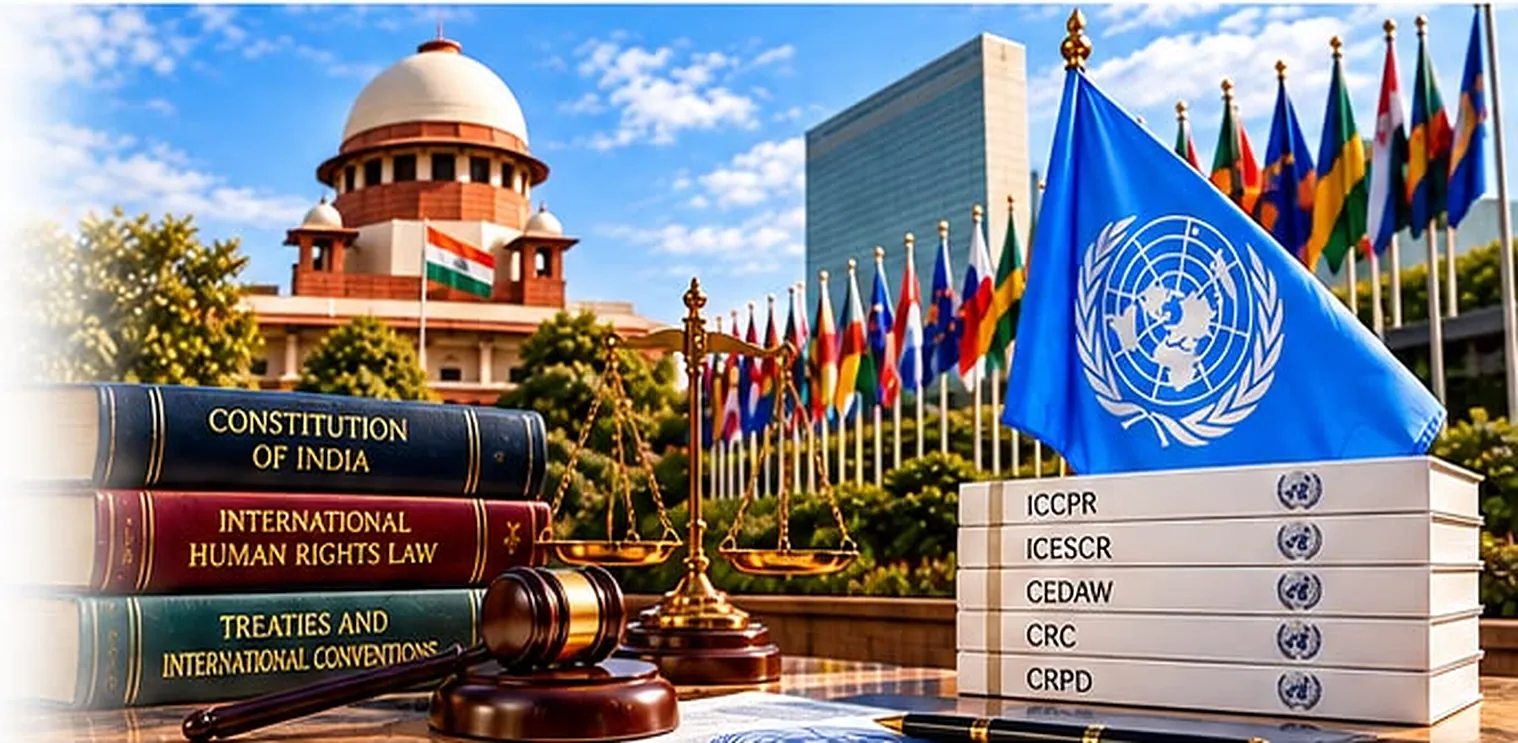
Key Topics on International Law & Human Rights in India

International law and human rights in India concern the relationship between international principles, treaty obligations and the Indian legal framework. Relevant subjects include internationally recognised rights, constitutional values, international agreements and the interaction between international standards and domestic law. Their relevance in India must be considered within the Constitution, legislation and applicable judicial interpretation.
International treaties and conventions form an important part of international law. India participates in bilateral and multilateral agreements concerning human rights, international cooperation and other cross-border subjects. The domestic relevance of treaty obligations must be understood within the Indian constitutional and legislative framework, including Article 51 of the Constitution.
See also: constitutional, writ and administrative law matters; NRI and cross-border matters.
International human-rights law addresses standards relating to dignity, equality, liberty, non-discrimination and fundamental freedoms. India participates in major international human-rights instruments, including the ICCPR, ICESCR, CEDAW, CRC and CRPD. India’s position must be considered separately under each treaty, convention or related international instrument.
The Constitution of India provides the principal domestic framework for fundamental rights and constitutional protections. International human-rights principles may relate to subjects such as equality, liberty, dignity and fundamental freedoms. Their relevance must be considered together with constitutional provisions, Indian legislation and judicial interpretation.
The Protection of Human Rights Act, 1993 provides an important statutory framework for human-rights institutions in India. It addresses the National Human Rights Commission, State Human Rights Commissions and Human Rights Courts, and connects constitutional protections with defined international covenants within the statutory framework.
The National Human Rights Commission and State Human Rights Commissions are statutory institutions established within India’s human-rights framework. Their functions include consideration of specified human-rights matters, review of safeguards, research, awareness and study of international human-rights instruments within the scope of applicable legislation.
Civil and political rights concern subjects including life, liberty, equality before law, freedom of thought and expression, participation in public affairs and protection against specified forms of arbitrary State action. The ICCPR is one of the principal international instruments in this field, and India is a State party.
Economic, social and cultural rights cover areas such as work, health, education, social protection, adequate living conditions and participation in cultural life. The ICESCR is a principal international treaty addressing these rights. In India, these subjects may also intersect with constitutional principles, legislation and sector-specific legal frameworks.
International human-rights law contains specialised instruments concerning women, children and persons with disabilities. Important frameworks include CEDAW, the Convention on the Rights of the Child and the Convention on the Rights of Persons with Disabilities. These instruments address equality, dignity, protection, participation, accessibility and non-discrimination.
Refugee protection and statelessness are distinct areas of international law and human-rights concern. The 1951 Refugee Convention and 1967 Protocol form the principal international refugee framework, while specialised international instruments address statelessness. India is not a party to the 1951 Convention or 1967 Protocol, and refugee and statelessness issues should be distinguished from immigration and citizenship status.
See also: immigration and citizenship.
The United Nations human-rights framework includes international treaties, treaty bodies, the Universal Periodic Review and Special Procedures. These mechanisms differ in their legal basis, functions and scope. India’s position depends on the particular treaty, declaration, reservation or optional procedure concerned.
Human-rights issues in India may arise before different courts, tribunals, commissions and statutory authorities depending on the subject involved. Relevant institutions may include the NHRC, State Human Rights Commissions and Human Rights Courts where applicable. Human-rights concerns may also intersect with constitutional, administrative, civil, criminal, family, employment and other areas of Indian law.
See also: constitutional, writ and administrative law matters.
Related Legal Information
Related subjects include constitutional and administrative law, NRI and cross-border matters, immigration and citizenship, civil and criminal proceedings, family and matrimonial matters and other areas in which international or human-rights questions may intersect with Indian law.
Professional Scope & Jurisdiction
Dr. Anand Duggal is an Advocate registered to practise in India. This page contains general legal-awareness and informational material. Information concerning foreign laws or foreign jurisdictions is provided for general purposes only and does not imply admission, authorisation or entitlement to practise law in any foreign jurisdiction.